Potentials
A Potential object is a compiled interpolation of a given function. The Universe applies potentials to particles to calculate the net force on them.
For performance reasons, we found that implmenting potentials as interpolations can be much faster than evaluating the function directly.
A potential can be treated just like any python callable object to evaluate it:
>>> pot = m.Potential.lennard_jones_12_6(0.1, 5, 9.5075e-06 , 6.1545e-03, 1.0e-3 )
>>> x = np.linspace(0.1,1,100)
>>> y=[pot(j) for j in x]
>>> plt.plot(x,y, 'r')
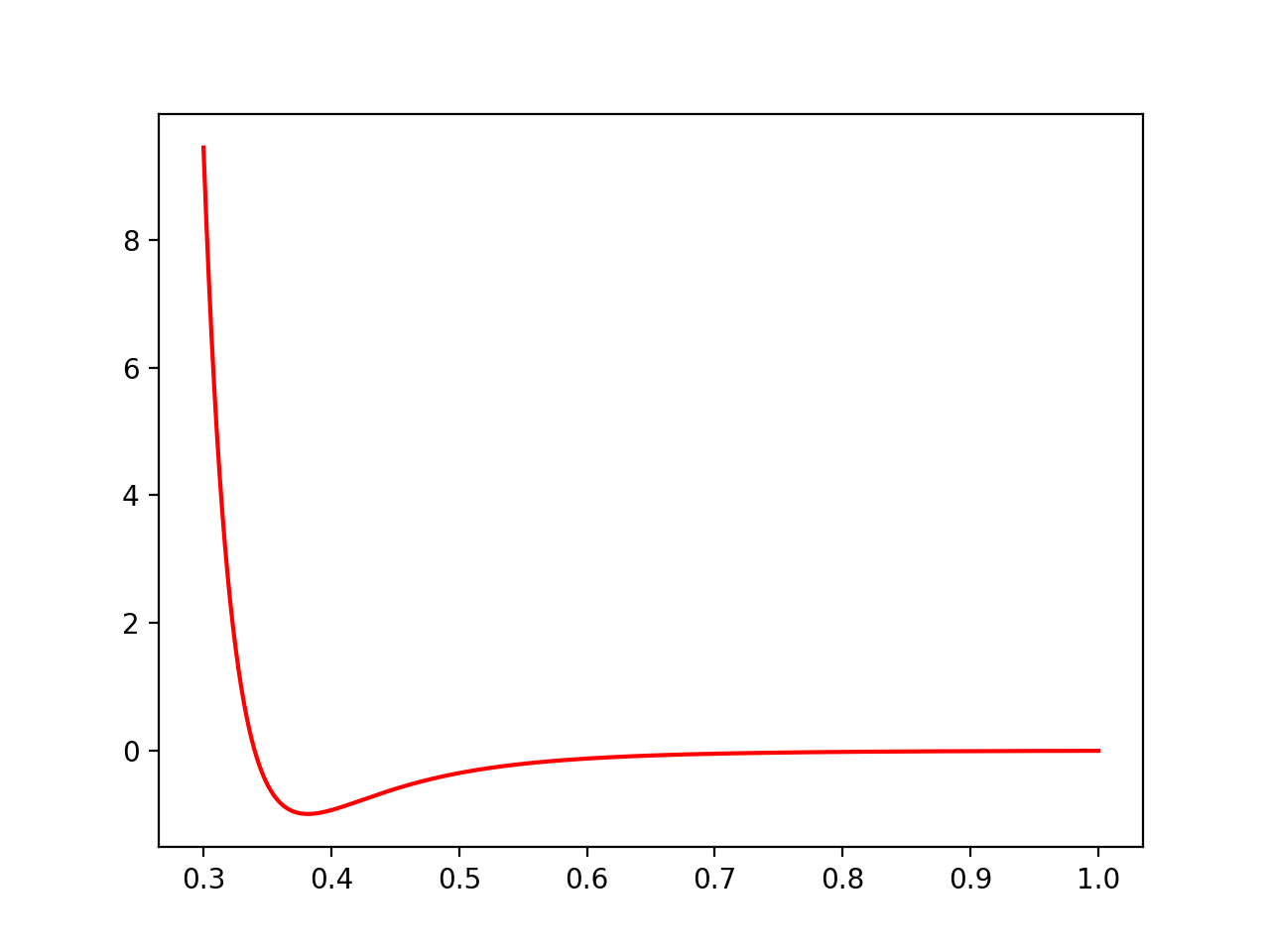
Potential is a callable object, we can invoke it like any Python function.
-
class
Potential¶ -
static
lennard_jones_12_6(min, max, a, b)¶ Creates a Potential representing a 12-6 Lennard-Jones potential
Parameters: - min – The smallest radius for which the potential will be constructed.
- max – The largest radius for which the potential will be constructed.
- A – The first parameter of the Lennard-Jones potential.
- B – The second parameter of the Lennard-Jones potential.
- tol – The tolerance to which the interpolation should match the exact potential., optional
The Lennard Jones potenntial has the form:
\[\left( \frac{A}{r^{12}} - \frac{B}{r^6} \right)\]
-
static
lennard_jones_12_6_coulomb(min, max, a, b, tol)¶ - Creates a Potential representing the sum of a
- 12-6 Lennard-Jones potential and a shifted Coulomb potential.
Parameters: - min – The smallest radius for which the potential will be constructed.
- max – The largest radius for which the potential will be constructed.
- A – The first parameter of the Lennard-Jones potential.
- B – The second parameter of the Lennard-Jones potential.
- q – The charge scaling of the potential.
- tol – The tolerance to which the interpolation should match the exact potential. (optional)
The 12-6 Lennard Jones - Coulomb potential has the form:
\[\left( \frac{A}{r^{12}} - \frac{B}{r^6} \right) + q \left(\frac{1}{r} - \frac{1}{max} \right)\]
-
static
ewald(min, max, q, kappa, tol)¶ Creates a potential representing the real-space part of an Ewald potential.
Parameters: - min – The smallest radius for which the potential will be constructed.
- max – The largest radius for which the potential will be constructed.
- q – The charge scaling of the potential.
- kappa – The screening distance of the Ewald potential.
- tol – The tolerance to which the interpolation should match the exact potential.
The Ewald potential has the form:
\[q \frac{\mbox{erfc}( \kappa r)}{r}\]
-
static
foo(more stuff)
-
static